Sider

mandag den 1. juli 2019

Mutations in the IDO2 gene and DNA methylations in genes in the NAD/NADP synthesis pathway in ME

Results shown at the NIH ME/CFS conference indicate that all of the 20 of the severely ill ME patients had damaging mutations in their indolamine 2,3-dioxygenase 2 (IDO2) gene (1,2).

The enzymes IDO1 and IDO2 catalyze the conversion of tryptophan to N-formyl-kynurenine. This is the first step in the kynurenine pathway and in the de novo pathway of biosynthesis of  NAD+  and  NADP+  (3).

Use link below to see "Biosynthesis of NAD(P)+ in mammalian cells" (3):
https://www.ncbi.nlm.nih.gov/pmc/articles/PMC5737637/figure/f2/

NAD+ is synthesized by three pathways: 

  • the de novo pathway
  • the Preiss–Handler pathway
  • the salvage pathway 


All of the enzymes in these three pathways are thoroughly described in reference 3. Some of these enzymes show up in ME research:

NAMPT = nicotinamide phosphoribosyltransferase. NAMPT is an enzyme in the salvage pathway.
NADSYN1 = NAD synthetase 1. NADSYN1 is an enzyme in the Preiss–Handler pathway.
QPRT = quinolinate phosphoribosyltransferase. QPRT is an enzyme the de novo pathway.
NADK = NAD kinase. NADK catalyzes the transfer of a phosphate group from ATP to NAD to generate NADP.

NAMPT gene expression was increased in whole blood from adolescent ME/CFS patients (adjusted p-value = 0,0621) (4).

NAMPT gene expression was increased in peripheral blood mononuclear cells (PBMC) from ME patients (5).


DNA methylations of genes in PBMC from ME patients:
  • NADSYN1 hypermethylated (gene probe cg 03146219) (6)
  • NADSYN1 hypomethylated (5'UTR) (7)
  • QPRT differentially methylated (1stExon) in ME patient subtypes (8)
  • NADK hypermethylated (gen probe cg00343906) (6)
  • NADK hypermethyltated (body) (9)
  • NADK differentially methylated (body) in ME patient subtypes (8)
  • NADK hypometylated (TSS1500) (7)


Kynurenine Is a Cerebrospinal Fluid Biomarker for Bacterial and Viral Central Nervous System Infections

The tryptophan-kynurenine-nicotinamide adenine dinucleotide (oxidized; NAD+) pathway is closely associated with regulation of immune cells toward less inflammatory phenotypes and may exert neuroprotective effects. Investigating its regulation in central nervous system (CNS) infections would improve our understanding of pathophysiology and end-organ damage, and, furthermore, open doors to its evaluation as a source of diagnostic and/or prognostic biomarkers (10).

The Trp-Kyn-NAD+ pathway is activated in CNS infections and provides highly accurate CSF biomarkers, particularly when combined with standard CSF indices of neuroinflammation (10).

The ME metabolic trap hypothesis predicts dysregulated Trp-Kyn- pathway in immune cells from ME patients (11).


Is the Trp-Kyn-NAD+ pathway dysregulated in the cerebrospinal fluid from ME patients?


References

1) National Institute of Health ME/CFS konference april 2019,
del 1: https://videocast.nih.gov/summary.asp?live=31636&bhcp=1
del 2: https://videocast.nih.gov/summary.asp?Live=31640&bhcp=1

2)  Health Rising,   NIH ME/CFS Conferencen, april 2019:
https://www.healthrising.org/blog/2019/04/10/nih-accelerating-chronic-fatigue-exhaustion-inflammation/

3) Xiao et al: NAD(H) and NADP(H) Redox Couples and Cellular Energy Metabolism Antioxid Redox Signal. 2018 Jan 20;28(3):251-272. doi: 10.1089/ars.2017.7216. Epub 2017 Jul 28.
https://www.ncbi.nlm.nih.gov/pubmed/28648096

4) Nguyen et al: Whole blood gene expression in adolescent CFS: an exploratory crosssectional study suggesting altered B cell differentiation and survival. J Transl Med. 2017,15,102.  https://www.ncbi.nlm.nih.gov/pubmed/28494812

5) 12) Sweetman et al: Changes in the transcriptome of circulating immune cells of a New Zealand cohort with myalgic encephalomyelitis/chronic fatigue syndrome. Sweetman et al: Int J Immunopathol Pharmacol. 2019 Jan-Dec;33:2058738418820402. doi: 10.1177/2058738418820402.
https://www.ncbi.nlm.nih.gov/pubmed/30791746

6) 4) de Vega et al: DNA methylation Modifications associated with CFS. PlosOne, 2014, 9, 8. https://journals.plos.org/plosone/article?id=10.1371/journal.pone.0104757

7) Trivedi et al: Identification of ME/CFS - associated DNA methylation patterns. Plos One 2018, 13, 7 https://journals.plos.org/plosone/article?id=10.1371/journal.pone.0201066

8) de Vega et al: Integration of DNA methylation & health scores identifies subtypes in ME/CFS. Epigenomics 2018, 10, 5 https://www.futuremedicine.com/doi/full/10.2217/epi-2017-015

9) de Vega et al: Epigenetic modifications and glucocorticoid sensitivity in ME/CFS. BMC Medical Genomics, 2017, 10, 11 https://www.ncbi.nlm.nih.gov/pmc/articles/PMC5324230

10) Sühs et al: Kynurenine Is a Cerebrospinal Fluid Biomarker for Bacterial and Viral Central Nervous System Infections J Infect Dis. 2019 Jun 5;220(1):127-138. doi: 10.1093/infdis/jiz048.
https://www.ncbi.nlm.nih.gov/pubmed/30721966

11) Metabolic Traps in ME/CFS - Research Update by Dr. Robert Phairhttps://www.youtube.com/watch?v=Quh-77gvw4Q

lørdag den 29. juni 2019

IDO-ME hypotesen er forenelig med AHR-MCS hypotesen

ME hypotesen "the metabolic trap" beskriver dysregulering af første trin i  kynurenine stivejen i immun celler fra ME patienter, idet tryptofan ikke omsættes til N-formyl-kynurenine i tilstrækkelig omfang  af enzymerne IDO1 og IDO2 (1).

ME patienter har kemikalie intolerance - også kaldet Multiple Chemical Sensitivity (MCS).

de Luca et al skrev i 2010, at en mulig forklaring af MCS kunne være dysregulering af Aryl Hydrocarbon Receptor (AHR) og/eller cytochrome P450 enzymerne (CYPs) (2).

AHR er en ligand-aktiveret transkriptionsfaktor, der bliver aktiveret af små molekyler fra (3):

  • kosten
  • metabolitter fra kynurenine stivejen
  • mikroorganismer på vores slimhinder
  • forurening


Anvend link til at se figur med AHR ligander (3): 
https://www.ncbi.nlm.nih.gov/pmc/articles/PMC5777317/figure/F2/

Se også tabel 1 over AHR ligander i artiklen (3).

AHR og IDO1/2 har et tæt samarbejde. AHR inducerer ekspression af IDO1/2, og kynurenine-metabolitterne dannes down-stream IDO1/2.

Den aktiverede AHR inducerer dannelsen af forskellige CYPs. CYPs nedbryder AHR liganderne, så AHR kan deaktiveres igen.

Anvend link til at se figur med AHR/CYP samarbejde (3):
https://www.ncbi.nlm.nih.gov/pmc/articles/PMC5777317/figure/F1/

IDO/KYN-metabolitterne/AHR - aksen er med til at holde immunforsvaret i balance. Det gælder i særdeleshed for  næsens slimhinder og tarmens slimhinder (3).

Indånding af skimmel er noget, der kan gøre en ME/MCS patient ganske syg. IDO er med til at inducere tolerance i næsens slimhinder, og mutationer i IDO-generne har betydning for kroppens reaktion på skimmel infektion (4, 5, 6).


Referencer

1) Metabolic Traps in ME/CFS - Research Update by Dr. Robert Phair
https://www.youtube.com/watch?v=Quh-77gvw4Q

ME hypotese: The Metabolic Trap - den metaboliske fælde
http://followmeindenmark.blogspot.com/2019/06/me-hypotese-metabolic-trap-den.html

2) de Luca et al: Biological definition of multiple chemical sensitivity from redox state and cytokine profiling and not from polymorphisms of xenobiotic-metabolizing enzymes. Toxicol Appl Pharmacol. 2010 Nov 1;248(3):285-92. doi: 10.1016/j.taap.2010.04.017. Epub 2010 Apr 27. https://www.ncbi.nlm.nih.gov/pubmed/20430047

3) Gutiérrez-Vázquez C Quintana FJ : Regulation of the Immune Response by the Aryl Hydrocarbon Receptor. Immunity. 2018 Jan 16;48(1):19-33. doi: 10.1016/j.immuni.2017.12.012. https://www.ncbi.nlm.nih.gov/pubmed/29343438

4) van der Marel AP1, Samsom JN, Greuter M, van Berkel LA, O'Toole T, Kraal G, Mebius RE.
Blockade of IDO inhibits nasal tolerance induction. J Immunol. 2007 Jul 15;179(2):894-900.
https://www.ncbi.nlm.nih.gov/pubmed/17617580

5) Paveglio et al: Airway epithelial indoleamine 2,3-dioxygenase inhibits CD4+ T cells during Aspergillus fumigatus antigen exposure Am J Respir Cell Mol Biol. 2011 Jan;44(1):11-23. doi: 10.1165/rcmb.2009-0167OC. Epub 2010 Jan 29 https://www.ncbi.nlm.nih.gov/pubmed/20118221

6) Napolioni et al: Genetic Polymorphisms Affecting IDO1 or IDO2 Activity Differently Associate With Aspergillosis in Humans Front Immunol. 2019 May 7;10:890. doi: 10.3389/fimmu.2019.00890. eCollection 2019. https://www.ncbi.nlm.nih.gov/pubmed/31134053

mandag den 24. juni 2019

Is the kynurenic acid responsive Gpr35 involved in the ME pathomechanism?

The ME hypothesis "the metabolic trap" tell us that IDO function in immune cells may be compromised (1).

IDO1 and IDO2 catalyze the first step in the kynurenine pathway: The conversion of tryptophan to N-formyl-kynurenine.  N-formyl-kynurenine can be converted to kynurenine (KYN). KYN can be further processed to kynurenic acid (KYNA).

Germain et al showed decreased levels of L-kynurenine / Formyl-5-hydroxykynurenamine in plasma from ME patients (2). Is the KYNA plasma level changed in ME patients?

Agudelo et al have shown (in mice) that kynurenic acid increases energy utilization by activating G protein-coupled receptor Gpr35, which stimulates lipid metabolism, thermogenic, and anti-inflammatory gene expression in adipose tissue.  Kynurenic acid and Gpr35 enhance Pgc-1α1 expression and cellular respiration, and increase the levels of Rgs14 in adipocytes, which leads to enhanced beta-adrenergic receptor signaling (3).

Furthermore, KYNA has been reported to have anti-inflammatory properties and to modulate cytokine release from invariant natural killer T (iNKT) cells through Gpr35 activation (4).

ME patients show alterations in expression of iNKT phenotypes (5, 6).

The gene GPR35 is hypomethylated in peripheral blood mononuclear cells (PBMC) from ME patients (p-value = 6,44E-08, FDR = 0,0029) (7).

Gpr35 is an interesting receptor, it also interacts with the sodium potassium pump. The sodium potassium pump (Na/K-ATPase) ensures the electrochemical gradient of a cell through an energy-dependent process that consumes about one-third of regenerated ATP. Schneditz et al. report that Gpr35 interacts with the α chain of Na/K-ATPase and promotes its ion transport and Src signaling activity in a ligand-independent manner (8).

Is the kynurenic acid responsive Gpr35 involved in the ME pathomechanism?


References:


1) Metabolic Traps in ME/CFS - Research Update by Dr. Robert Phair 
https://www.youtube.com/watch?v=Quh-77gvw4Q

2) Germain et al: Metabolic profiling of a ME/CFS discovery cohort reveals disturbances in fatty acid and lipid metabolism. Mol. BioSyst. 2017, 13, 371 https://pubs.rsc.org/en/Content/ArticleLanding/2017/MB/C6MB00600K#!divAbstract

3) Agudelo et al: Kynurenic Acid and Gpr35 Regulate Adipose Tissue Energy Homeostasis and Inflammation. Cell Metab. 2018 Feb 6;27(2):378-392.e5. doi: 10.1016/j.cmet.2018.01.004.
https://www.cell.com/cell-metabolism/fulltext/S1550-4131(18)30053-6?_returnURL=https%3A%2F%2Flinkinghub.elsevier.com%2Fretrieve%2Fpii%2FS1550413118300536%3Fshowall%3Dtrue

4) Fallarin et al: Expression of functional GPR35 in human iNKT cells. Biochem Biophys Res Commun. 2010 Jul 30;398(3):420-5. doi: 10.1016/j.bbrc.2010.06.091. Epub 2010 Jun 25.
https://www.ncbi.nlm.nih.gov/pubmed/20651116

5) Ramos er al: Regulatory T, natural killer T and γδ T cells in multiple sclerosis and chronic fatigue syndrome/myalgic encephalomyelitis: a comparison. Asian Pac J Allergy Immunol. 2016 Dec;34(4):300-305. doi: 10.12932/AP0733. https://www.ncbi.nlm.nih.gov/pubmed/27001659

6) Hardcastle et al: J Transl Med. 2015 Sep 14;13:299. doi: 10.1186/s12967-015-0653-3.
Longitudinal analysis of immune abnormalities in varying severities of Chronic Fatigue Syndrome/Myalgic Encephalomyelitis patients. https://www.ncbi.nlm.nih.gov/pubmed/26370228
7) Trivedi et al: Identification of ME/CFS - associated DNA methylation patterns.
Plos One 2018, 13, 7 https://journals.plos.org/plosone/article?id=10.1371/journal.pone.0201066

7) Trivedi et al: Identification of ME/CFS - associated DNA methylation patterns.
Plos One 2018, 13, 7 https://journals.plos.org/plosone/article?id=10.1371/journal.pone.0201066

8) Schneditz et al. GPR35 promotes glycolysis, proliferation, and oncogenic signaling by engaging with the sodium potassium pump. Sci Signal. 2019 Jan 1;12(562). pii: eaau9048. doi: 10.1126/scisignal.aau9048. https://www.ncbi.nlm.nih.gov/pubmed/30600262

tirsdag den 18. juni 2019

Kynurenine metabolisme påvirkes af motion

ME hypotesen "the metabolic trap" beskriver dysregulering af første trin i  kynurenine stivejen i immun celler fra ME patienter, idet tryptofan ikke omsættes til N-formyl-kynurenine i tilstrækkelig omfang (1).

Fra forskning i depression ved man, at kynurenine stivejen påvirkes af motion, og man ved, at depression er forbundet med forhøjede niveauer af kynurenine. Det er således ikke det samme, der er galt med ME patienter (ifølge hypotesen), men vi kan lære noget om kynurenine stivejen ved at se på forskning i depression.

Forskere fra Karolinska Institutet i Sverige har i forsøg med mus vist, at kynurenine stivejen påvirkes ved motion (2):

  • Enzymet AMPK er vigtig for regulering af glukose ligevægten og kroppens tilpasning til motion. AMPK styrer disse funktioner gennem proteinerne PGC-1alfa1, PPAR-alfa og PPAR-delta.
  • Ved motion danner musklerne  PGC-1alfa1. Proteinet inducerer dannelsen af mitokondrier og øger fedtsyrer oxidationen.
  • Sammen med proteinerne PPAR-alfa og PPAR-delta inducerer PGC-1alfa1 også dannelsen af enzymerne kynurenine aminotransferaser (KATs) i musklerne.
  • KATs omdanner kynurenine (KYN) til kynurenic acid (KYNA). Det betyder, at plasma niveauet af  KYN bliver lavere og plasma niveauet af KYNA bliver højere.
  • KYN er en neuro-toksisk metabolit. KYN kan krydse blod-hjerne-barrieren (BBB). Det kan KYNA ikke. Dvs. motion sænker plasma niveauet af KYN, så mindre KYN kan krydse BBB.
  • Man mener, at motion afhjælper depression, fordi der sker en øget omsætning af KYN til KYNA.
Figur 7 fra reference 2 viser ovenstående forløb

En let forståelig oversigtsartikel, Muscle over Mind, beskriver ligeledes ovenstående studie. Og viser denne figur over forsøget med mus:
https://www.ncbi.nlm.nih.gov/pmc/articles/PMC6016023/figure/F1/

Det kunne være interessant at få målt niveauet af kynurenine metabolitter i muskelceller, i plasma og i cerebrospinalvæske fra ME patienter før, under og efter motion.

Referencer

1) Metabolic Traps in ME/CFS - Research Update by Dr. Robert Phair
https://www.youtube.com/watch?v=Quh-77gvw4Q

2) Agudelo et al: Skeletal muscle PGC-1α1 modulates kynurenine metabolism and mediates resilience to stress-induced depression. Cell. 2014 Sep 25;159(1):33-45. doi: 10.1016/j.cell.2014.07.051.  https://www.ncbi.nlm.nih.gov/pubmed/25259918

mandag den 17. juni 2019

CTLA-4 induces IDO and SOCS3 drives degradation of IDO

The ME hypothesis "the metabolic trap" tell us that IDO function in immune cells may be compromised (1).

Dendritic cells (DCs) and T cells work together to maintain immune tolerance.

Cytotoxic T-lymphocyte associated protein 4 (CTLA-4) downregulates the immune response. CTLA-4 binds to CD80 or CD86 on the surface of DCs. As a result DCs produce the tolerogenic tryptophan - catabolizing enzyme IDO (2):

Use links to figures:
https://www.ncbi.nlm.nih.gov/pmc/articles/PMC6380512/figure/F1/
https://www.ncbi.nlm.nih.gov/pmc/articles/PMC6380512/figure/F2/

Mutations in the gene CTLA4 have been associated with insulin-dependent diabetes mellitus, Graves disease, Hashimoto thyroiditis, celiac disease, systemic lupus erythematosus, thyroid-associated orbitopathy, and other autoimmune diseases (3).

Antibodies to thyreoperoxidase, to beta-adrenergic and muscarinic cholinergic receptors have been found in some ME patients (4).

Rheumatic heart disease is mediated by autoimmune reactions. Rheumatic fever and rheumatic heart disease lesions result from a complex network of several genes that control both the innate and adaptive immune responses after a S. pyogenes throat infection. An inflammatory process permeates the development of heart lesions with high production of inflammatory cytokines (IFNγ, TNFα, IL-17 and IL-23) and low numbers of cells producing IL-4, a regulatory cytokine of inflammation. Autoreactive CD4+ T cells infiltrate the heart tissue and trigger autoimmune reactions through molecular mimicry. A mutation in CTLA4 that affect the inhibitory function is found in some patients with rheumatic heart disease (5).

Autoimmunoreactive IgGs against cardic membrane proteins have been found in patients with POTS (6).

I wonder if some ME/POTS patients may have mutations in both IDO2 and CTLA4?

SOCS3 drives degradation of IDO

SOCS3 drives proteasomal degradation of indoleamine 2,3-dioxygenase (IDO) and antagonizes IDO-dependent tolerogenesis (7, 8).

Use link to figure (7): https://www.ncbi.nlm.nih.gov/pmc/articles/PMC2634889/figure/F7/

The transcription of SOCS3 has been found up-regulated in immune cells from ME patients (9).


References:


1) Metabolic Traps in ME/CFS - Research Update by Dr. Robert Phair
https://www.youtube.com/watch?v=Quh-77gvw4Q

2) Bourque J, Hawiger D: Immunomodulatory Bonds of the Partnership between Dendritic Cells and T Cells.  Crit Rev Immunol. 2018;38(5):379-401. doi: 10.1615/CritRevImmunol.2018026790.

3)  CTLA4 cytotoxic T-lymphocyte associated protein 4  https://www.ncbi.nlm.nih.gov/gene/1493

4) Loebel et al: Antibodies to β adrenergic and muscarinic cholinergic receptors in patients with Chronic Fatigue Syndrome. Brain Behav Immun. 2016 Feb;52:32-39. doi: 10.1016/j.bbi.2015.09.013. Epub 2015 Sep 21. https://www.ncbi.nlm.nih.gov/pubmed/26399744

5) Guilherme et al: Rheumatic Heart Disease: Genes, Inflammation and Autoimmunity. Rheumatol Curr Res 2012, S4 DOI: 10.4172/2161-1149.S4-001
https://www.longdom.org/abstract/rheumatic-heart-disease-genes-inflammation-and-autoimmunity-6499.html

6) Wang et al: Autoimmunoreactive IgGs against cardiac lipid raft-associated proteins in patients with postural orthostatic tachycardia syndrome. Transl Res. 2013 Jul;162(1):34-44. doi: 10.1016/j.trsl.2013.03.002. Epub 2013 Apr 3. https://www.ncbi.nlm.nih.gov/pubmed/23562385

7) Orabona et al. SOCS3 drives proteasomal degradation of indoleamine 2,3-dioxygenase (IDO) and antagonizes IDO-dependent tolerogenesis. Proc Natl Acad Sci U S A. 2008 Dec 30;105(52):20828-33. doi: 10.1073/pnas.0810278105. Epub 2008 Dec 16. https://www.ncbi.nlm.nih.gov/pubmed/19088199

8) Palotta et al: Proteasomal Degradation of Indoleamine 2,3-Dioxygenase in CD8 Dendritic Cells is Mediated by Suppressor of Cytokine Signaling 3 (SOCS3). Int J Tryptophan Res. 2010;3:91-7. Epub 2010 Jun 10. https://www.ncbi.nlm.nih.gov/pubmed/22084591

9) Sweetman et al: Changes in the transcriptome of circulating immune cells of a New Zealand cohort with myalgic encephalomyelitis/chronic fatigue syndrome. Sweetman et al: Int J Immunopathol Pharmacol. 2019 Jan-Dec;33:2058738418820402. doi: 10.1177/2058738418820402.https://www.ncbi.nlm.nih.gov/pubmed/30791746

fredag den 14. juni 2019

Is the ME hypothesis "the metabolic trap" able to explain endothelial dysfunction?

Vascular endothelial dysfunction has been measured in ME patients (1).

The ME hypothesis "the metabolic trap" tell us, that the first step in the kynurenine pathway is dysregulated (2).

Dysregulated kynurenine pathway is highly associated with endothelial dysfunction and has been correlated with several cardiovascular diseases (3).

Research indicates, that IDO can be nitrated and inactivated by peroxynitrite, and that nitration of IDO-Tyr15 is the most important factor for IDO inactivation (3).

Research in apolipoprotein E knock-out mice on a high fat diet has shown: Systemic IDO inhibition by 1-methyl tryptophan (1-MT) enhances vascular inflammation with upregulation of vascular cell adhesion molecule-1 (VCAM-1) and monocyte chemoattractant protein-1 (MCP-1/CCL2), and increasing CD68+ macrophage infiltration in vascular area. Moreover, IDO inhibition-induced acceleration of atherosclerosis and vascular inflammation can be reversed by exogenous administration of the Trp catabolite 3-hydroxyanthranilic acid (3-HAA ) (3).


References:


1) Mewton et al: Large and small artery endothelial dysfunction in chronic fatigue syndrome International Journal of Cardiology, 2012 Feb 9; 154(3):335–6
ME Research UK has described the study here: Large and small artery endothelial dysfunction in chronic fatigue syndrome

2) Metabolic Traps in ME/CFS - Research Update by Dr. Robert Phair https://www.youtube.com/watch?v=Quh-77gvw4Q

3) Song et al: Abnormal kynurenine pathway of tryptophan catabolism in cardiovascular diseases Cell Mol Life Sci. 2017 Aug;74(16):2899-2916. doi: 10.1007/s00018-017-2504-2. Epub 2017 Mar 17.  https://www.ncbi.nlm.nih.gov/pubmed/28314892

torsdag den 13. juni 2019

Tryptofan metabolitten kynureninsyre har immunmodulerende egenskaber

ME hypotesen "the metabolic trap" forudsiger højt niveau af tryptofan og lavt niveau af kynurenine inde i immuncellers cytoplasma (1).

Germain et al påviste lavt niveau af L-kynurenine / Formyl-5-hydroxykynurenamine i plasma fra ME patienter (2).

Kynurenine (KYN) kan omdannes til kynurenic acid (KYNA), på dansk kynureninsyre. Vi kan formode, at flere kynurenine metabolitter er påvirkede hos ME patienter - både i inde i cellerne, i plasma og i cerebrospinalvæsken. Så forhåbentlig er der forskere i gang med at bestemme niveauet af disse metabolitter, og hvad det kan betyde for ME sygdomsmekanismen. I mellemtiden kan vi læse om de enkelte metabolitters betydning for kroppen.

KYNA er en vigtig metabolit, der udøver immundæmpende effekt via GPR35- og AhR-associerede stiveje (3):


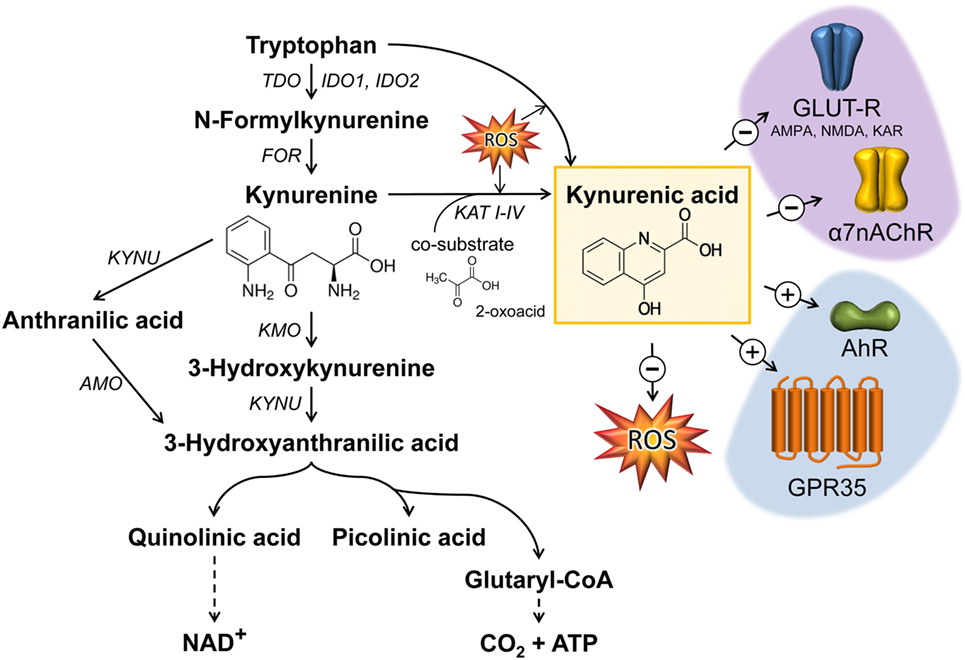
Figure 1. Kynurenic acid (KYNA) synthesis along the kynurenine pathway and its mode of action. The catabolism of TRP by the enzymes TDO or IDO represents the rate-limiting step in KYNA synthesis. The intermediate metabolite kynurenine can be further processed through three distinct pathways to form KYNA, 3-hydroxykynurenine, and anthranilic acid. KYNA is formed by the irreversible transamination of KYN either via kynurenine aminotransferases (KAT I–IV) or through the action of reactive oxygen species (ROS). KYNA is a non-competitive antagonist of ionotropic glutamate receptors (GLUT-R) as well as of the α7 nicotinic acetylcholine receptor (α7nAChR) expressed on neuronal cells. Apart from neuromodulatory properties, KYNA is an agonist of the broadly expressed G-protein-coupled receptor 35 (GPR35) and aryl hydrocarbon receptor (AhR). Furthermore, KYNA functions as an ROS scavenger. Black arrows mark enzymatic reactions and dashed arrows include more than one catalytic reaction step. FOR, formamidase; IDO, indolamine 2,3-dioxygenase; TDO, tryptophan 2,3-dioxygenase; TPH, tryptophan hydroxylase; KAT, kynurenine aminotransferase; KMO, kynurenine 3-monooxygenase; KYN, kynureninase; AMO, anthranilate 3-monooxygenase; AMPA, α-amino-3-hydroxy-5-methyl-4-isoxazolepropionic acid receptor; NMDA, N-methyl-d-aspartate receptor; KAR, kainate receptor.

Figuren er fra ref 3: Wirthgen et al (2018). Jeg kan varmt anbefale, at man læser hele artiklen.

Referencer:

1)  ME hypotese: The Metabolic Trap - den metaboliske fælde

2) Germain et al: Metabolic profiling of a ME/CFS discovery cohort reveals disturbances in fatty acid and lipid metabolism. Mol. BioSyst. 2017, 13, 371 https://pubs.rsc.org/en/Content/ArticleLanding/2017/MB/C6MB00600K#!divAbstract

3) Wirthgen E Hoeflich A, Rebl A, Günther J.: Kynurenic Acid: The Janus-Faced Role of an Immunomodulatory Tryptophan Metabolite and Its Link to Pathological Conditions
Front Immunol. 2018 Jan 10;8:1957. doi: 10.3389/fimmu.2017.01957. eCollection 2017.
https://www.frontiersin.org/articles/10.3389/fimmu.2017.01957/full